
Objects in the Heavens (OITHv7.0) is the pocket-size astronomy deep-sky fieldbook for viewing the night sky from the northern hemisphere. Includes descriptions and mapped locations of 761 celestial objects of all types to magnitude 10, all with 12.2031 RA/Dec addresses.
This handy pocket guide provides the reader with a lifetime list of great objects to observe. Every observer needs a good star atlas. But charts alone aren’t of much value in helping you decide what objects of the thousands plotted are worth looking at. Objects in the Heavens provides that essential guide.
– Alan Dyer
Read the full review
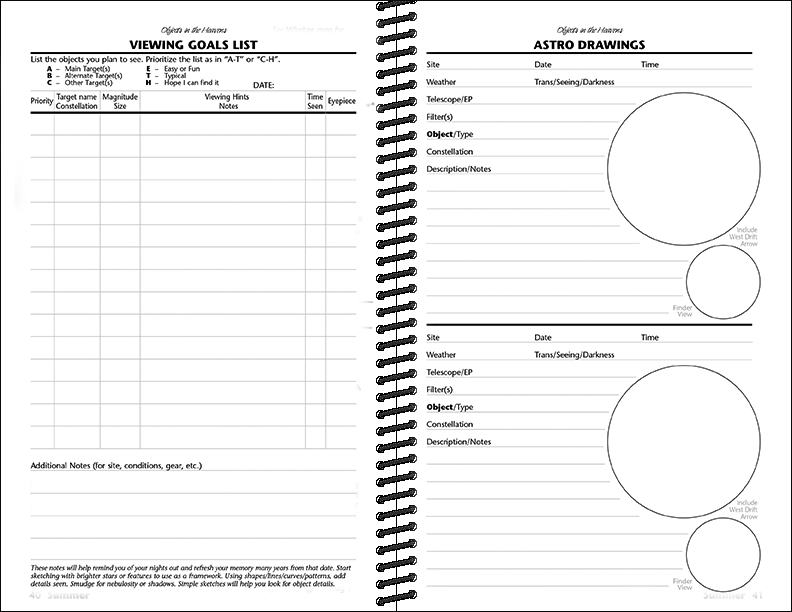
All known objects to magnitude 10 or brighter, visible with a 6-inch reflector from the northern hemisphere. Mag 7 and brighter ("city objects") are specially highlighted for use with average binoculars at a dark site, including 237 other-than-Messier or NGC objects. Data is assembled from 38 astronomical catalogs. Generous space is provided in the back for personal observation sketching and notes.
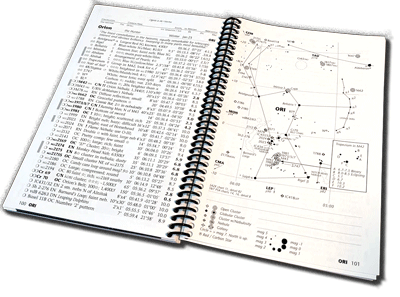
• 136 pages, lay-flat spiral-binding, soft cover, digest size: 5.5" x 8.5"
• 761 objects to magnitude 10
• 237 non-Messier or NGC objects, 28 of which are binocular-class
• 197 "city" objects to magnitude 7 are specially highlighted
• 181 double stars and multiple stars
• 262 binocular-class objects with separate symbol
• 122 visual associate connections
• 112 lunar targets
• 78 objects from mag 10.1 to 10.5
• 146 single and red/carbon stars
• 82 maps (constellational, seasonal, insets and groupings) and graphics
• 61 observable northern constellations, arranged alphabetically
• 38 astronomy catalogs are referenced
• 24 photographs by Naoyuki Kurita
• Star Stories that bring constellations together for a "big picture" view
• 9 pages featuring the Lunar 100 (and then some) with photos and locations showing when and where to look
• Encyclopedic data on planets, stars, meteors
• Common names list
• Modern Messier list of 110 objects with suggested Marathon constellation order
• Complete object number cross-reference and mapping
• Cross referenced to page numbers in PSA and SA2K
• 211 Galaxies
• 415 Open clusters
• 82 Globular clusters
• 106 Nebulae
• 31 Asterisms
• RA/Dec 12/2031
"A small, handy observing guide."
– Sky&Telescope
See the review
OITH is designed for both the casual viewer and experienced deep-sky hunter. By having useful information at your fingertips, in a format that's easy to use at home or at a dark site, you spend less time searching and more time viewing.
"A wealth of information in a clear, concise package."
– Astronomy Magazine
See the review
Have you wondered what you can actually see in the night sky? OITHv6 will help you find more objects from city sites or dark sites, with telescopes or binoculars.
"This is a very useful publication."
– Faith Jordan, The Web Society
Read the full review
It's an interactive reference book which brings together just the facts – and then some – to be a complete, useful and entertaining viewing companion. While OITH is not a photo book, the images included are close to what you can expect to see in your eyepiece. OITH provides many answers to: "What ALL can I see and where is it?" by providing only those objects which are potentially viewable from the Northern Hemisphere, formatted to simplify finding these visual treats with detailed constellation and seasonal maps. Featured are modern celestial locations, available descriptions, extensive cross-referencing, common names list and historic observational comments from T.W.Webb. The book's compact size also makes it ideal for camping and hiking.
In my professional career, I am a web developer / marketer, and in my amateur astronomy career I am an educator and inventor. I am looking at OITH right now – I love how dense and clear it is. You are a master typographer and info presenter!"
– Dan Cummings – https://starinastar.com
Aside from copious details on deep-sky objects, 9 pages are included on viewing the Moon so you can follow what's visible as Earth's "night light" goes through its phases during the month. (scroll to the bottom of THIS PAGE to see a sample spread)
Feedback and reader opinions are necessary for improving this effort. I now enjoy a great relationship with some amazing people who are properly thanked on the front acknowledgement page. The reviewers' page has many wonderful comments from astronomers of all experience levels, beginner to professional.
I hope you like this book as much as they do.
• • • • • • • • • • • • • • • • • •
Wow, this book is amazing! I've been in amateur astronomy for 23 years, and have used many field guides (Peterson's Stars and Planets, National Audubon Field Guide, David Dickinson's Back Yard Astronmers Field Guide, etc), but I have never been satified with any of these when it comes to observing aides. They are fine books with lots of information, but not useful in the field while actually observing.
I am most impressed with your attention to the detailed information that is actually useful and usable in the field. The information needed to find objects is very well presented in a form that is easy to read. The book is small and lays flat! I might appreciate this feasture most of all!
Well done!
Jeff Tucker
Danville, IN
Sept.23, 2023
• • • • • • • • • • • • • • • • • •
Order the GLS separately or save a few bucks by ordering both books together HERE.
I enjoy the quiet of the country and my preference for hobbies springs from that attraction. Astronomy has not only been a particular focus of study culminating with this book, it's best done far from city lights and Chicago has a lot of them. My other main interest (aside from my family) is hang gliding, which dates from 1975 and is also best done in places far from the city.
My fascination with astronomy had several false starts but, like an old Harley-Davidson in need of a tune-up, it needed one more kick to get it going. My father pointed out a very red Mars when I was about 8 or 9, then I witnessed the 1966 Leonids, spent a year near the equator and saw our neighbor galaxies. But none of that really worked. The final kick start was seeing Jupiter through a friend's 8" reflector in '94. Wow! I had to learn more.
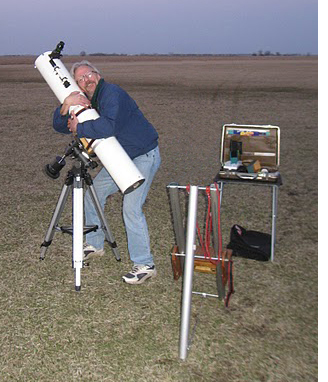 What started out as simply "what can I see" with my new (very old and rescued) 6-inch reflector lead to a quest to find every object of magnitude 10 or brighter. The mag-10 limit was originally set as it's the practical limit of the 6" scope in average suburban skies. This turned out to be a fair limiting factor as more and more objects were uncovered. The search itself involved dozens of libraries, 100's of books and magazines, and literally thousands of websites. Each time new data was collected, the humble list increased, eventually growing beyond my wildest dreams, from 260 total objects in the first edition to now an eye-filling 761. That basic first list took on a life of its own and, of course, became the book presented here.
The photography used in the book since the first edition was graciously provided by Naoyuki Kurita of Tokyo, Japan. His website is a terrific resource for everyone.
Thank you for considering OITH for your library.
Calvin and Hobbs ©Bill Watterson
Powered by w3.css