
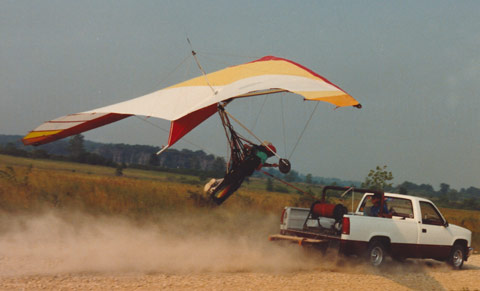
Instructor Marty Bunner with student Joe Birren on the 2.6 mile runway at Bong Park, Wisconsin
The following was written by Gordon Marshall,
Sky Sports Flying School, Western Australia
The winch is a machine that provides a constant line tension while paying out (or pulling in) the rope during a tow.
A great deal of effort has gone into the resurrection & redesigning of this magnificent beast, since its kind donation from 'the Bunbury Boys', resulting in a machine that provides a quick, safe, efficient & tidy method of becoming airborne.
The journey, from its first arrival and test flights (5km around a paddock at 70 kmh & 300' agl) to now, has been a long & very trying one, many weekends and a huge learning curve have however been worth the effort (I keep telling myself).
Mr. Stewart McVey has been the untiring workhorse behind this modern miracle of masterly technological achievement, incorporating many innovative features never seen before on a piece of state-of-the-art aviation equipment, without having to take out business loans. A disk brake replaced the drum brake, an air-conditioning clutch was incorporated onto the new rewind motor, an old speedo was coupled to the increased diameter rope drum, a line tension gauge was introduced, along with the brake pressure gauge. Replacing the steel rod with a ring thing at the end is the new line leveling system which is achieved with a combination of Datsun Stanza windscreen wiper motor, a couple of solenoids, some relays, some very beefy wiring, fancy linear bearings, bike chain, a sprocket, & two shiny grease nipples, (a lot simpler solution don't you think ?) A one stop control lever finish it all off. (thanks also to Turtle for the blue flashing light).
The reasoning behind the winch is that we can tow on a narrow strip into most any wind direction without the rope ever touching the ground, crops, fence, power lines, etc.. This makes it the ideal towing method for our situation at Wyalkatchem, Western Australia. The winch is a machine that provides a constant line tension while paying out the rope during the tow. This is achieved by winding the rope onto a drum that is attached to a disk brake assembly, the brake pressure can be adjusted to give different line tension corresponding to the amount of pressure applied to the brake, thereby giving control to the line tension.
The first different thing you may notice when about to tow is your close proximity to the tow car. This gives you a feeling of rapid height gain for the first 100ft climb. Usually this is an illusion based upon your previous experiences of static line towing when the car is 100s of feet away (don't panic). The thing to remember here is that this is a PAYOUT winch so the rope won't break and the weaklink will survive.
The next sensation is in flight, with the car and yourself staying in the same relationship, just getting farther and farther away from each other. Encountering a thermal is far less stressful, you don't have to yank the bar in at the first sign of lift, the winch simply pays out as much rope as you need. This saves many a weak link and also allows you to climb further.
Driving the winch may at first sound and look complicated but really there is not much to it, the worst mistake you can make is driving too slow, if you drive too fast the winch simply pays out more rope, so the rule of thumb is "if in doubt - drive faster".
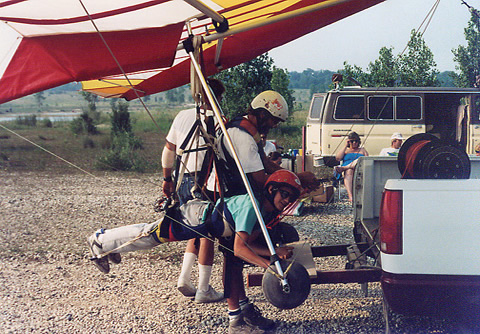
Instructor Marty Bunner and Joe Birren getting ready for a tandem payout at Bong Park, Wisconsin
This article is only a guide to the use of one particular payout winch and is not a self-teaching manual. Before attempting to tow behind any new or different piece of equipment please seek the proper training.
Controls –
One lever controls all functions.
Push forward = pressure on.
Pull back = pressure off.
Thumb wheel = main pressure adjustment.
Lever rotate = minor pressure up or down.
Press button = rewind. Instruments.
Brake pressure gauge / line tension gauge / drum rotation speedometer.
Rope: 3000' of 5/32" spectra, very expensive, do not use as a static line or drag it along the ground. For joining the rope use splicing tool (& instructions sheet) or fisherman's knot. Parachute: very expensive Pilots responsibility to repack the chute prior to each launch. DO NOT DRAG THE CHUTE THRU THE REWIND ASSEMBLY (it won't kill you, but club members will).
Maintenance System Checklist –
Pre-flight the winch in much the same way as you would your glider.
Check rope (knots, frayed etc.).
Rope leveler (bearings, dirt, clean linear shaft etc.).
Battery terminals & batteries.
Disk brake and brake fluid level (2 master cylinders)
Parachute (carabiners, rips, bag, etc.).
At the end of the day remove the battery terminals off the two batteries (avoid flat batteries). Report any problems.
Command sequence for towing –
Pilot- " Brake off & drive forward... Stop".
Driver - "Brake on and adjusted".
Pilot -"Mike locked on, walking back for tension, bridle is free, nose is down, wind is–--, wings are level, go go go."
Pilot-"Safe release, thanks for the tow."
(editor comment – this is one group's set of commands. The commands in the USA and at other sites will likely be different.)
Remember to keep the communication simple, this way the driver can pick up key words over the noise of the tow car.
Driver Operation –
Clip pilot onto the rope. With brake off drive forward (slowly) until pilot says stop. The distance from pilot to tow car varies depending on the wind strength: 25 meters on a windy day (10kmh+) 100 meters on nil & variable days.
Apply brake and rotate lever full on, adjust brake pressure to correspond with maximum towing tension. Rotate lever 1/4 of a turn off and radio to pilot "brake on & adjusted". On pilot's (correct) command to go, drive the first 1 meter slow then accelerate rapidly! One hand on the lever and both eyes on the rear view mirror. Do not attempt to change gears until the pilot is safely off the ground (if manual transmission).
If you hear anything that sounds like "Stop Stop Stop" do so immediately by braking hard and dumping the line tension. This method stops the tow process in about 2 meters!
Accelerate to pilot's desired airspeed. After pilot has achieved approx. 200'agl, increase line tension by rotating lever clockwise. Keep one hand on the control at all times so as to adjust tow line tension throughout the duration of the tow. During the tow the drum will pay out the rope. The rule of thumb is that if the drum is not rotating you are not driving fast enough.* (maintain constant air speed).
When the pilot enters a thermal the drum speed will increase rapidly, rotate the lever anti-clockwise to allow the pilot to maximize the lift with minimum wing loading. When the pilot encounters sink or is not in lift reapply the maximum pressure. (Clockwise) These adjustments are not compulsory, they just aid the pilot in achieving max height. One problem that may be encountered during the tow is pitch oscillations, this will show up on the drum speedo and by the pilot yelling abuse. To overcome these, increase car speed quickly, then slow back down to original speed...gradually.
At the end of the tow after pilot says "Released safely," point car into the wind, release brake & press rewind button. It will take a minute or so for the rope to be almost be in. Stop when the parachute is approximately 20 meters from the car by releasing button & reapplying the brake. If the rewind malfunctions stop immediately, you may have to rewind the rope manually. Place the chute & rope in the back of the car and drive back, positioning the car ready for the next tow. If you're feeling confident, flying the chute back is a neat trick.
Time is an important factor to consider. Fast and efficient turn around is the key especially on those light and scariable days when the window of launch opportunity is small. You need to get the car back and the driver hooked up a.s.a.p.. so as s/he is ready to go when the opportunity comes.
In Flight on the Tow –
It is important to keep the correct relationship to the tow car, (sweet spot) flying just faster than trim usually works. In lift there is no need to pull in , maximize the lift, the winch will just pay out more rope. It is perfectly OK to pin off under tension, the important things are: 1-safe release 2- the bloody thermal!
Warning, upon release under certain circumstances the line parachute may inflate rapidly and climb into the flight path of your glider. To avoid this situation always turn the glider immediately upon safe release.
Towing Pressure –
For most pilots there won't be much difference in the initial brake pressure adjustment, however, the rule of thumb is the heavier the pilot the higher the tow pressure required.
Take-Off Direction –
Point the glider square into the wind and point the car down the track (up to 45 deg cross wind is OK) leaving approximately 25 to 50 meters between glider and car. Make sure that your wings are level, run into the wind. You will notice that the wind will appear to change direction after a couple of steps and the glider will yaw toward the car (relative air flow is a neat trick, eh?)
Driver speed verses pilot air speed * After the T.O. the pilot will climb through the wind gradient. After this the relative airspeed will remain approximately the same in lift, sink or normal flight, so it is important for the driver to maintain a constant groundspeed allowing the pilot to make the necessary pitch alterations to maintain the 'sweet spot.' If you appear to be falling back behind the tow car pull the bar in, you will be surprised that you will still be going up Of course there are always those areas of extreme sink where you must drive the car a lot faster. Remember, if the drum is not paying out you're not driving fast enough.
Still to come features: Auto rewind counter (involves a microprocessor thingie & another of those Datsun Stanza windscreen wiper motors) ... Auto brake pressure adjustment (more microprocessors & lots of mathematics) ... Manual rewind handle ... Another winch (portable) ... A Dragonfly?????? ... virtual flying
DISCLAIMER: As with all aviation endeavors, your choice and use of equipment is totally up to you. It is assumed you are an experienced HG or PG tow pilot who is intimately familiar with the style of towing you will be doing. As such, YOU ASSUME ALL RISK AND LIABILITY in the use of the Linknife, as well as all other parts, functions and personnel involved in the towing and flight operations. If you do not have experience in towing, please contact an instructor for expert training. Trying to learn on your own can, and probably will, result in your injury and even death. Many pilots have paid the ultimate price so we may now tow as safely as never before possible. Please learn from their lessons.
Linknife Home | Static Line | Payout/Platform | Aerotow | Testimonials
Reel Pilots Home |
Hewett's Towing Criteria |
Driver SOP
Static Line Basics |
Static Towing Parts |
Hewett Bridle Basics
Parachutes |
Lockouts |
Payout Primer |
Flying Sites
Links clubs/info |
Links2 states/countries
Airshow |
Site Opening Primer
Birren Design Company | Site Map
©2000-2023 Peter Birren email
Powered by w3.css